🗓 Released Nov 3, 2026
🔁
Cycle Advice
BuyFirst-generation product — recently released, still early days
💰
Deals Advice
neutralNo upcoming deals on the radar
First-generation product — recently released, still early days
No upcoming deals on the radar
Key strengths
Swaptek keeps nine tools docked, loaded and pre-heated, each with its own filament path and heater. Bambu quotes 6-second material switches and very small purge volumes per swap, so multi-material prints waste far less filament than single-nozzle AMS printing.
Each tool can carry a different nozzle size or material. That makes it possible to print a 0.2 mm detail section, a 0.4 mm structural part and a soft 75A TPU section in one job.
The AMS 3H stores and feeds filament inside a sealed unit, and a built-in dryer handles moisture-sensitive PA, PC and TPU. Older AMS units can connect for up to 24 spools.
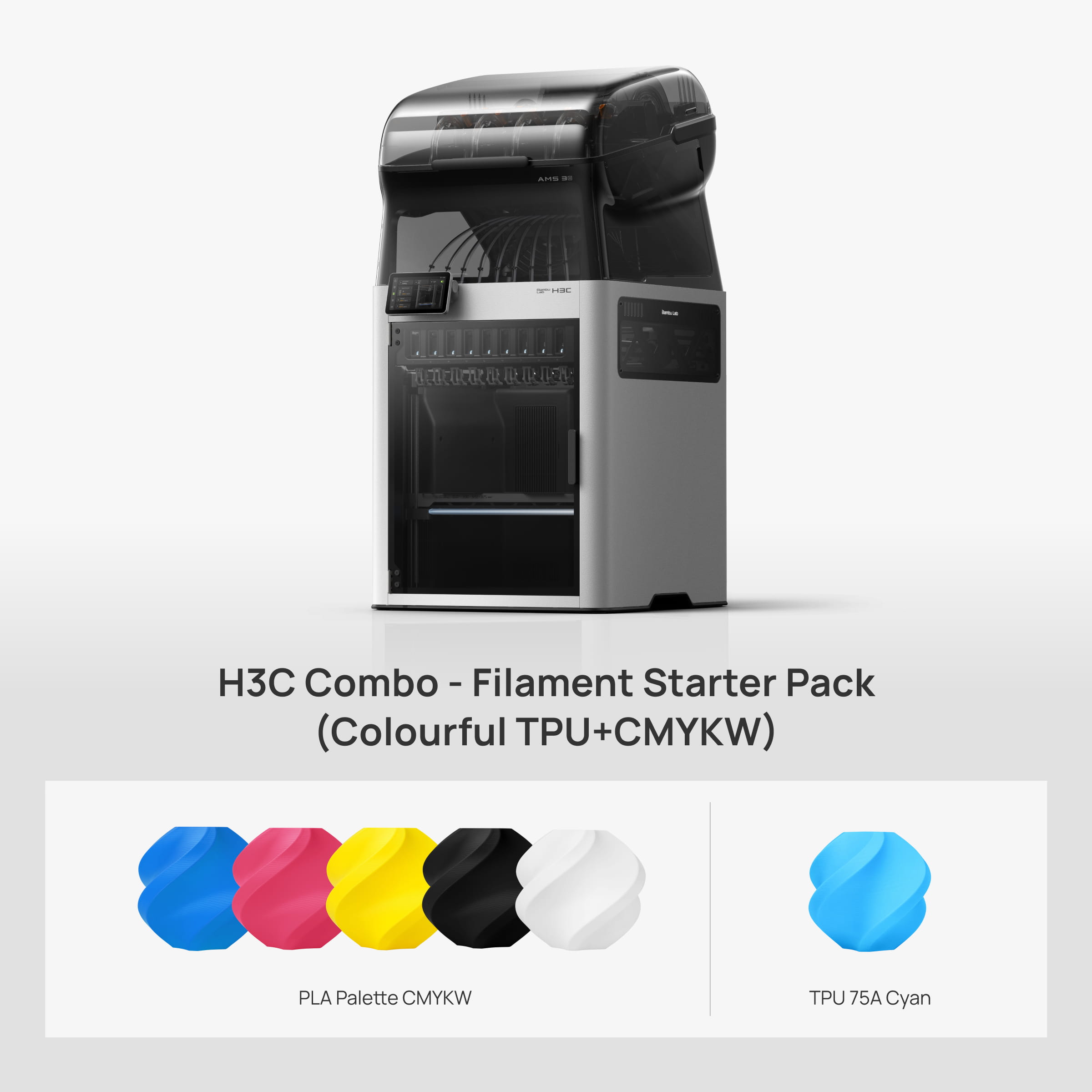
The Bambu Lab H3C, launched on 3 November 2026, is Bambu's nine-tool H-line tool changer. Its Swaptek system keeps nine PrintTools docked, loaded and pre-heated, each with its own filament path and heater, and Bambu quotes 6-second material switches. It keeps the 330×320×325 mm build volume of the H2C and adds a 65°C actively heated chamber, a 350°C nozzle, travel speeds up to 1,400 mm/s, and the AMS 3H, an enclosed filament system with a built-in dryer. Older AMS units can connect through PrintTool No. 1 to support up to 24 spools. Optional CraftTools (cut, draw, deboss) mount the same way. It sells as the H3C Combo for $2,499, with bundles up to $3,049. It sits above the H2C, which Bambu says will remain available.
The H3C went on sale on 3 November 2026, so it is at the start of its cycle and nothing newer has been announced. The trade-off is maturity: early buyers get first-batch hardware and launch firmware, and Bambu rarely discounts a new flagship in its first months. If you need a tool changer for production now, buying at launch is reasonable. If you can wait, the 2027 summer sale is the first realistic discount window.
Both have the same 330×320×325 mm build volume. The H2C ($2,399) uses Vortek hotend swapping with up to 6 hotends. The H3C ($2,499) has 9 docked PrintTools, Bambu-quoted 6-second material switches, a 65°C chamber and the AMS 3H with a built-in dryer. For $100 more, the H3C gives you more tools and faster swaps. Bambu says the H2C will remain available, so watch for H2C price cuts if 6 hotends are enough for you.
Both aim for near-zero-waste multi-material printing. The Prusa CORE One L+ INDX 8-Tool is open source, uses Bondtech's INDX toolchanger with 8 tools on a 298×275×330 mm build area, and is on pre-order. The H3C has 9 tools, a slightly larger build area, faster quoted swaps, and Bambu's more turnkey software, and it is available now. Choose Prusa for open hardware and repairability. Choose the H3C for speed and plug-and-play setup.
Yes. The H3C has a 350°C nozzle and a 65°C actively heated chamber, and the AMS 3H's built-in dryer covers moisture-sensitive PA, PC and carbon-fibre-filled filaments. Because each tool has its own material, you can combine an engineering structural material with PVA soluble supports or flexible TPU in the same print.
The $2,499 H3C Combo includes the printer and the AMS 3H filament system. Bundles with filament starter packs start at $2,589, and the full combo with the Bambu Station and E1 Air Purifier is $3,049. The BirdsEye top-view camera, CraftTools (cut, draw, deboss) and extra hotends in other nozzle sizes are sold separately.