🗓 Released Dec 1, 2025
🔁
Cycle Advice
BuyFirst-generation product — recently released, still early days
💰
Deals Advice
neutralNo upcoming deals on the radar
First-generation product — recently released, still early days
No upcoming deals on the radar
Key strengths
The Max4 offers the largest build volume in Qidi's lineup — enabling large functional parts, architectural models, and production batch runs that exceed Plus4 capacity.
The Max4's closed-loop XY adds positional feedback for improved accuracy at high speeds — a differentiating feature at this price tier that reduces dimensional errors on large prints.
Qidi's proven active chamber heating technology scaled to a 390×390 mm bed — critical for consistent ABS, ASA, PA-CF, and PPS-CF results across the full build plate.
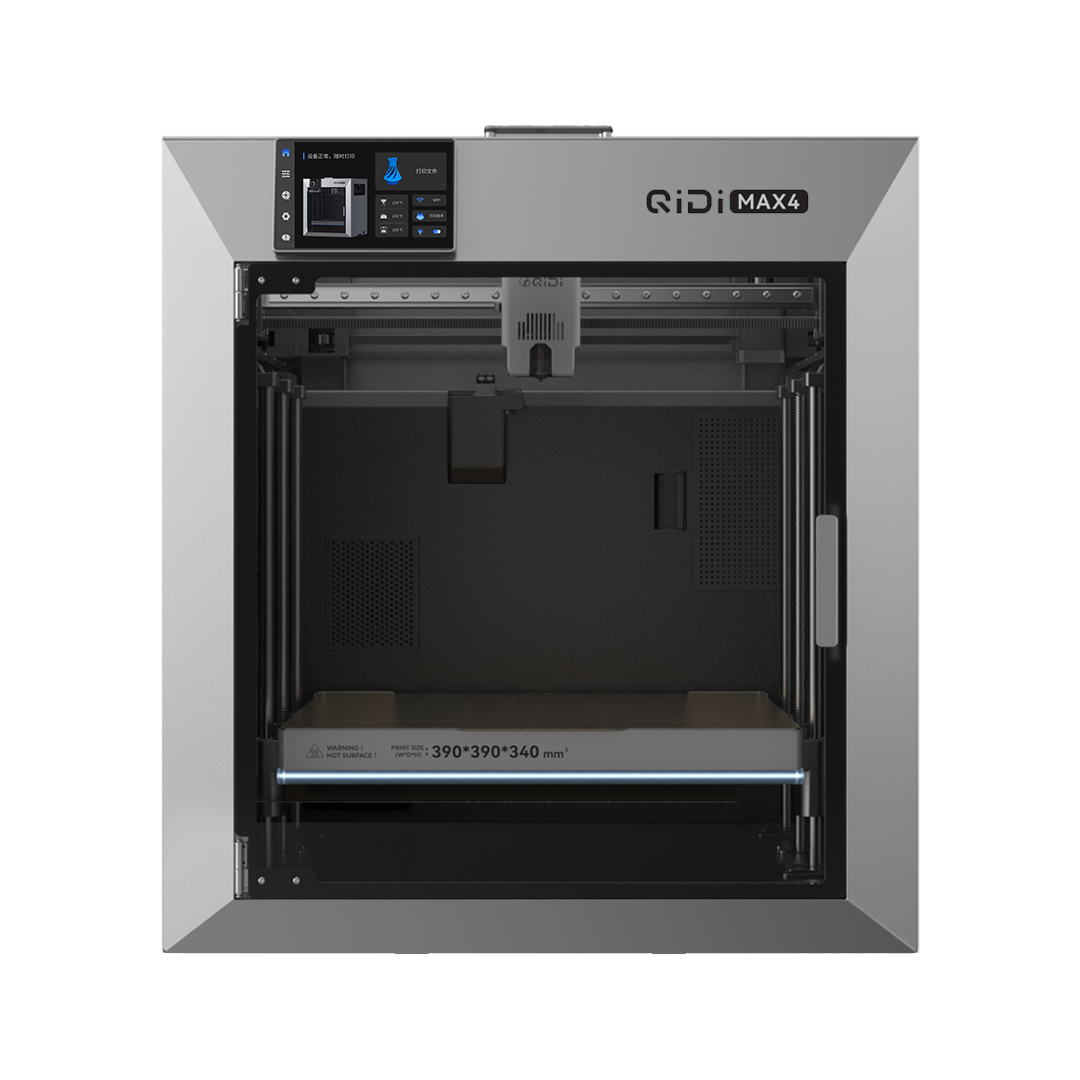
The Qidi Tech Max4, debuted at Formnext November 2025, is Qidi's largest printer to date. Its 390×390×340 mm enclosed build volume, active 65°C chamber heating, and closed-loop XY motion system position it as Qidi's flagship large-format professional printer. It is compatible with the Qidi Box multicolor system for up to 4-color printing.
The Plus4 ($699) offers a 305×305×280 mm build volume at a significantly lower price. The Max4 provides a 390×390×340 mm build volume with closed-loop XY motion and is Qidi's flagship professional tier. If you regularly print parts that exceed 300×300 mm, the Max4 justifies its higher price. For most users, the Plus4 is the better value.
The Bambu H2S ($999–1,299) has a 340×320×340 mm build volume at 1000 mm/s with Bambu's polished ecosystem and AMS 2 Pro multicolor. The Max4 offers a larger 390×390×340 mm build volume with closed-loop XY and Qidi's active chamber heating at a potentially lower price — but with a less mature software ecosystem. If ecosystem quality, speed, and community matter, the H2S. If maximum build volume is the priority, the Max4.
Closed-loop XY uses encoder feedback to verify the actual position of the print head, correcting any deviations caused by missed steps, resonance, or mechanical compliance. On a printer as large as the Max4 — where long travel distances amplify small positioning errors — closed-loop motion is a meaningful quality improvement over standard open-loop stepper-based CoreXY systems. The result is better dimensional accuracy on large prints at high speeds.